Our Office: 4100 32nd Ave. S. Fargo, ND 58104
Quietly powering through
For more than a century, the Red River of the North has shaped life in the Fargo-Moorhead area. The river flows north across some of the flattest land in the country, a remnant of glacial Lake Agassiz, and that combination makes the region one of the most flood-prone in the United States. Major floods struck in 1897, 1950, 1997, 2009 and 2011. The 1997 flood that overwhelmed Grand Forks and East Grand Forks caused an estimated $3.5 billion in damage, and in 2009 the river reached its highest level on record in the Fargo-Moorhead area.
Those events set the stage for one of the largest infrastructure projects the region has ever seen: the FM Area Diversion. And while the diversion is best known for its channel, levees and control structures, a quieter story runs beneath and beside all of it. To make the project possible, thousands of feet of electric line had to be moved, rebuilt, buried or retired. Much of that work fell to Cass County Electric Cooperative.
The FM Area Diversion is a roughly 30-mile channel designed to route floodwaters around the metro area, paired with about 20 miles of levees, a series of control structures, aqueducts that let existing rivers cross naturally, and an upstream water retention area. The Metro Flood Diversion Authority oversees the channel and associated infrastructure, while the U.S. Army Corps of Engineers is responsible for the southern embankment. It is a project that, once completed, will cost more than $3 billion, involving roughly 30 federal, state and local agencies and around 20 utility companies.
It is also the first public-private partnership flood control project in North America. The target for delivering permanent, reliable flood protection is 2027.
The project intersected with CCEC infrastructure throughout the area, requiring coordination across nearly every section. The work broke down into several major areas: crossings and reroutes along the diversion channel, retirements and line work in the southern embankment and upstream retention area, the Wild Rice and Red River control structures, the inlet structure to the channel, and a long list of member buyouts and accounts that had to be re-fed.
Along the channel route alone, crews dealt with 33 separate conflicts: seven crossings, five reroutes and 21 line retirements. In the southern embankment area, the cooperative built 23.5 miles of new underground line to replace, reroute or re-feed member accounts. Crews also retired 14.4 miles of overhead line, the poles and wires most people picture when they think of a power line, along with 9.1 miles of buried underground cable and 91 individual services. All told, the diversion has generated more than 100 separate projects for the cooperative, from single service retirements to full substation work. Crews have logged nearly 13,000 hours on them since the first job opened in 2017.
The project pushed the cooperative into unfamiliar territory. To cross beneath the diversion channel, crews pulled nearly half a mile of cable through conduit in a single run. Before this project, CCEC had rarely pulled cable more than about 1,500 feet at a time. The longer pulls required detailed engineering calculations up front to confirm they were even possible, larger conduit to ease the pulls, and specially ordered reels of cable long enough to run from one side to the other without a splice. One contractor purchased a new reel trailer just to handle the size and weight.
The project was designed to keep every cable splice off Corps property, so any future repair would happen on adjacent land rather than under the channel. On the south side, where crews could not bore beneath the dam, lines had to run up and over the embankment instead, a reverse of the same challenge. Much of the conduit was encased in concrete, a permanent commitment that left little room for second chances.
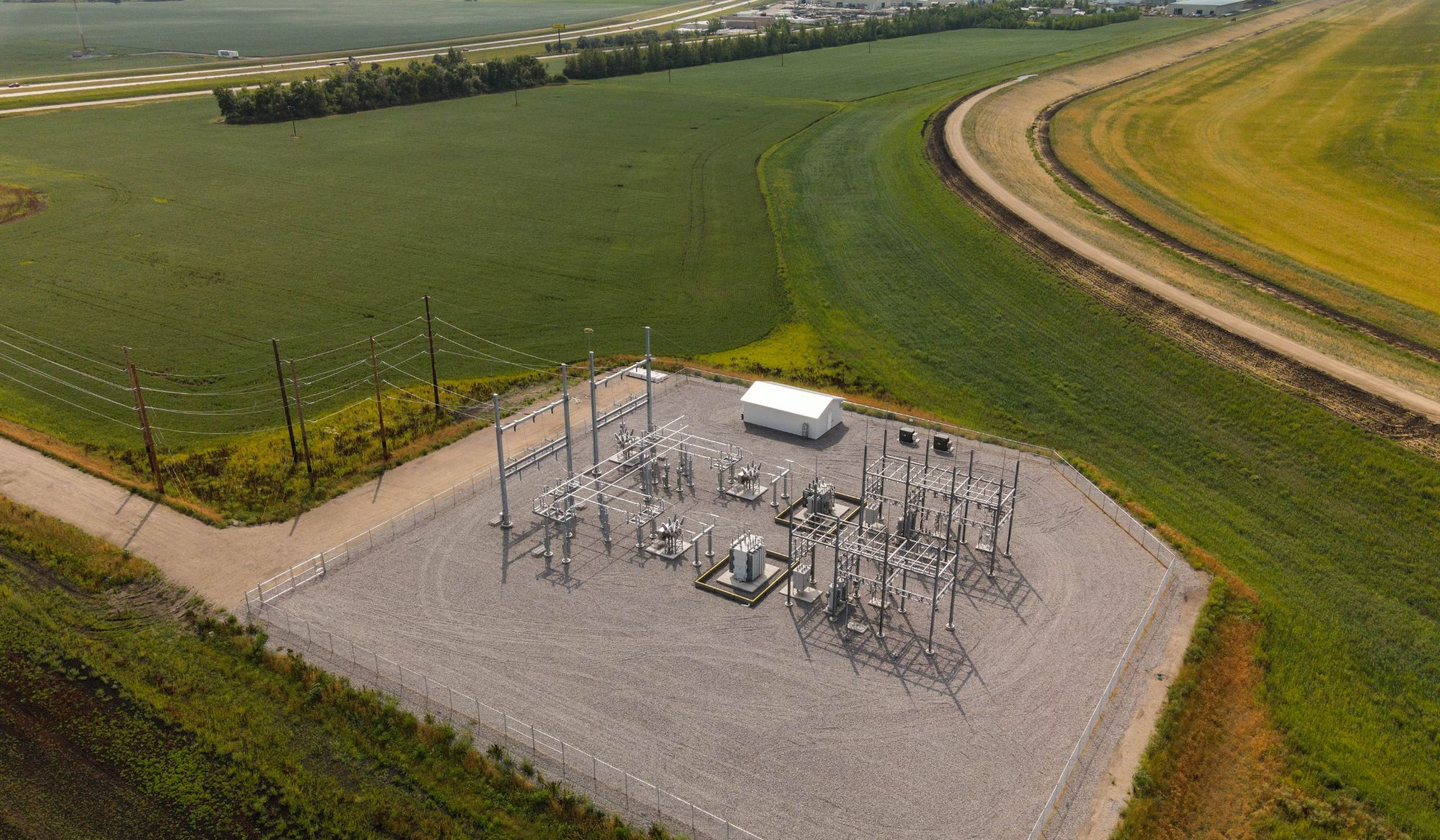
This was not a quick job. CCEC opened its first work order tied to the diversion in 2017, years before formal agreements were in place, and the cooperative has been meeting with project partners roughly every other week for the past three years. The effort also included relocating the Oxbow substation, moving two large diesel generators about 18 miles southwest to the Colfax substation, and coordinating closely with landowners, the Corps, the diversion authority, and its engineering partners.
Through it all, CCEC’s approach stayed consistent: Do the work that needs to be done, do it safely, and keep members connected. Because much of the relocation and rebuilding was driven by the diversion rather than by growth within the cooperative’s own system, careful planning, coordination, and resource management were essential. Most project-related costs were reimbursed rather than carried by members.
The FM Area Diversion will stand as a generational investment in the region’s protection from flooding. The channel and structures will get most of the attention. But the line crews, engineers, and planners who quietly moved the power out of the way made sure the lights stayed on while it was built.