Our Office: 4100 32nd Ave. S. Fargo, ND 58104
Rising to the challenge
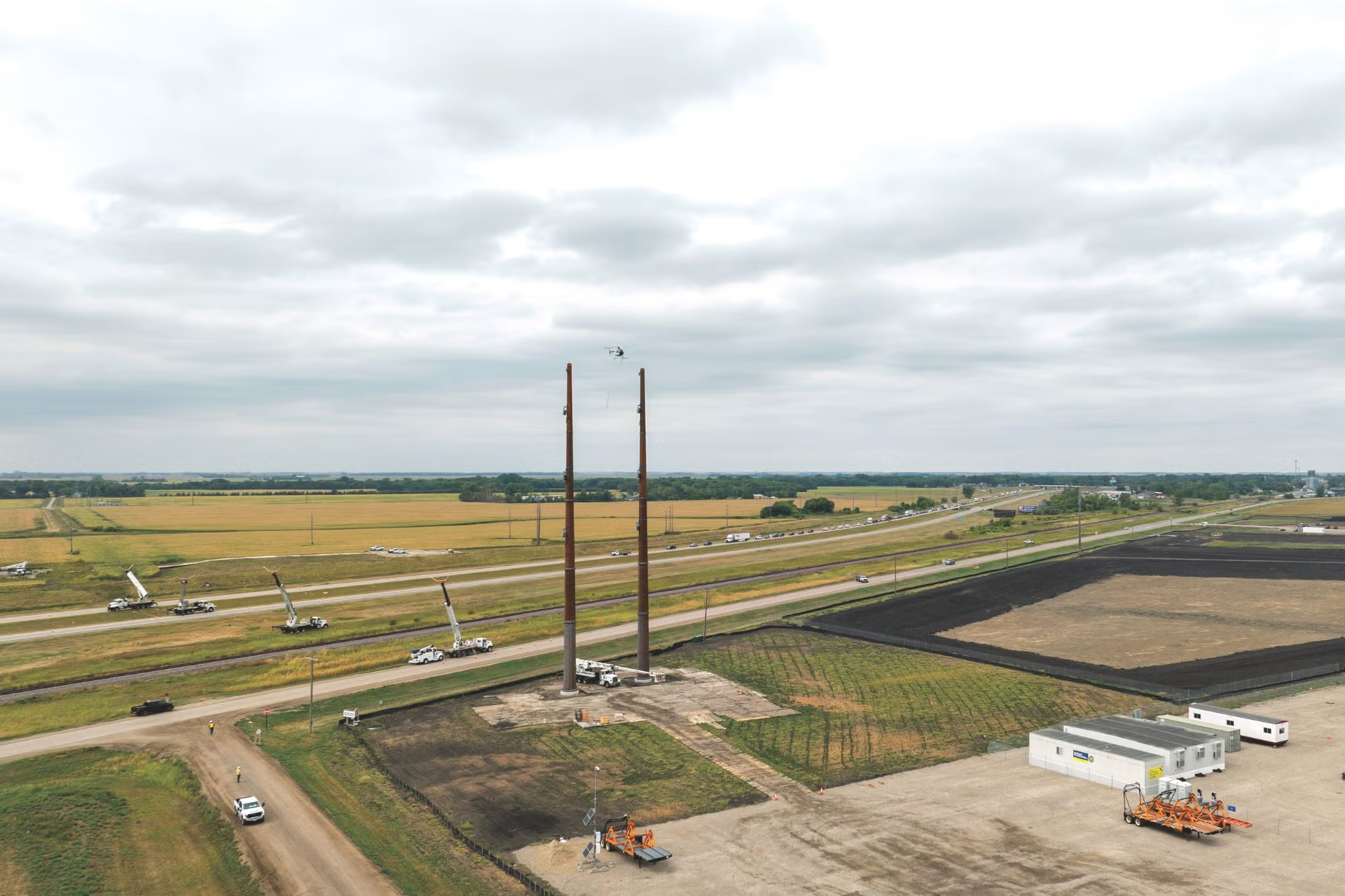
As the general foreman for High Country Line Construction, Shaun Biller had a challenging job on the morning of Aug. 30. He was organizing an effort to pull a series of straw lines (or heavy wire ropes) through four 345-kilovolt (kV) transmission structures. Over a railroad. And a county highway. And a four-lane interstate. With a helicopter.
“Today is a complex day as far as for a pull. It’s not bad, but we have a lot of moving parts this morning,” Biller explained to the safety meeting attendees surrounding him. “Everything’s going to have to be coordinated and communicated.”
The complexity of this mission was reflective of the entire power project at hand. Minnkota Power Cooperative and several contracted partners were in the middle of one of the cooperative’s largest endeavors to date, building more than a mile and a half of 345-kV transmission line and a new substation to help power a 280-megawatt (MW) data center under construction near Harwood, North Dakota.
Applied Digital, now a business member of Cass County Electric Cooperative (CCEC), began construction of its Polaris Forge 2 AI Factory in September 2025 with a goal to partially energize the facility by fall of 2026. All the new electric infrastructure would be paid for by Applied Digital, but the work itself would need to be done by the professionals. With a timeline that short and an ask that large, Minnkota and CCEC knew they would need to call in reinforcements.
Kara Laframboise, Minnkota’s project manager overseeing the planning, design and construction of the new transmission line and substation (called Agassiz), says Minnkota began looking for an engineering, procurement and construction (EPC) contractor and consultant right away. The co-op ultimately joined forces with the firm Burns & McDonnell, who gathered the rest of the contractors who would help complete the project in record time.
Serving a 280-MW load is not something Minnkota takes lightly. The leadership team knew well before Applied Digital that they would be facing growing requests of this kind. They developed a large load interconnection process for projects of 20 MW or more, through which applicants would agree to pay for not only the studies needed to ensure the project wouldn’t negatively impact Minnkota’s system and membership, but also for any new infrastructure necessary to serve the project.
When the large load interconnection process was ready in early 2025, Applied Digital was the first applicant in the queue, ready to pay for any system upgrades to serve their Harwood data center. After deep discussions with their respective boards, Minnkota and CCEC got to work.
“We needed engineering studies on the transmission side and on the distribution side to find out if we could feasibly serve this load,” said CCEC President and CEO Paul Matthys. “That was step one. Step two was determining if we have the energy capacity to serve them. And the answer is we do. In many cases, the Minnkota system is long on energy.”
Through the early stages of exploring the data center project, Matthys and his co-op team engaged with their membership, fielding many questions about how the data center would impact their electric rates. Rates would not go up as a result of the data center, Matthys told them. In fact, the data center could actually help stabilize rates by paying a larger portion of the fixed costs of upgrades in the area, which would be needed to keep power reliable in the quickly growing region.
As work progresses on the new Agassiz substation, Minnkota, CCEC and Applied Digital have worked in partnership to answer lingering questions about the data center project. The companies have been involved in public meetings, site tours, informational panels, and other print and digital communications to tell the Polaris Forge 2 story.
“One of the great parts of the cooperative model is we are owned and governed by the members that we serve, so there’s a trust there, and we never want to do anything to jeopardize that,” Matthys said.
In Harwood, Laframboise watched as the helicopter delicately threaded the straw line through a pulley at the top of a 145-foot-tall transmission pole. In the next moment, the pilot pulled the line across Interstate 29, where Sunday traffic had been flagged to a temporary stop.
This day of work alone took the coordination of at least seven contracted companies and local entities. Laframboise says this level of collaboration has become common for the project.
“A large part of my role is to help our EPC contractor keep everyone else on pace,” she said. “Now, we’re at a point where we’re going to be taking this over at the end of the day, so we want to be involved a bit more so we can take it over with confidence.”
The challenges of providing power to Polaris Forge 2 have been great: assessing and mitigating reliability risks, organizing the experts, securing substation materials, and doing it all at the speed-to-market pace expected by the AI sector. But the anticipated benefits will prove to be well worth the work.